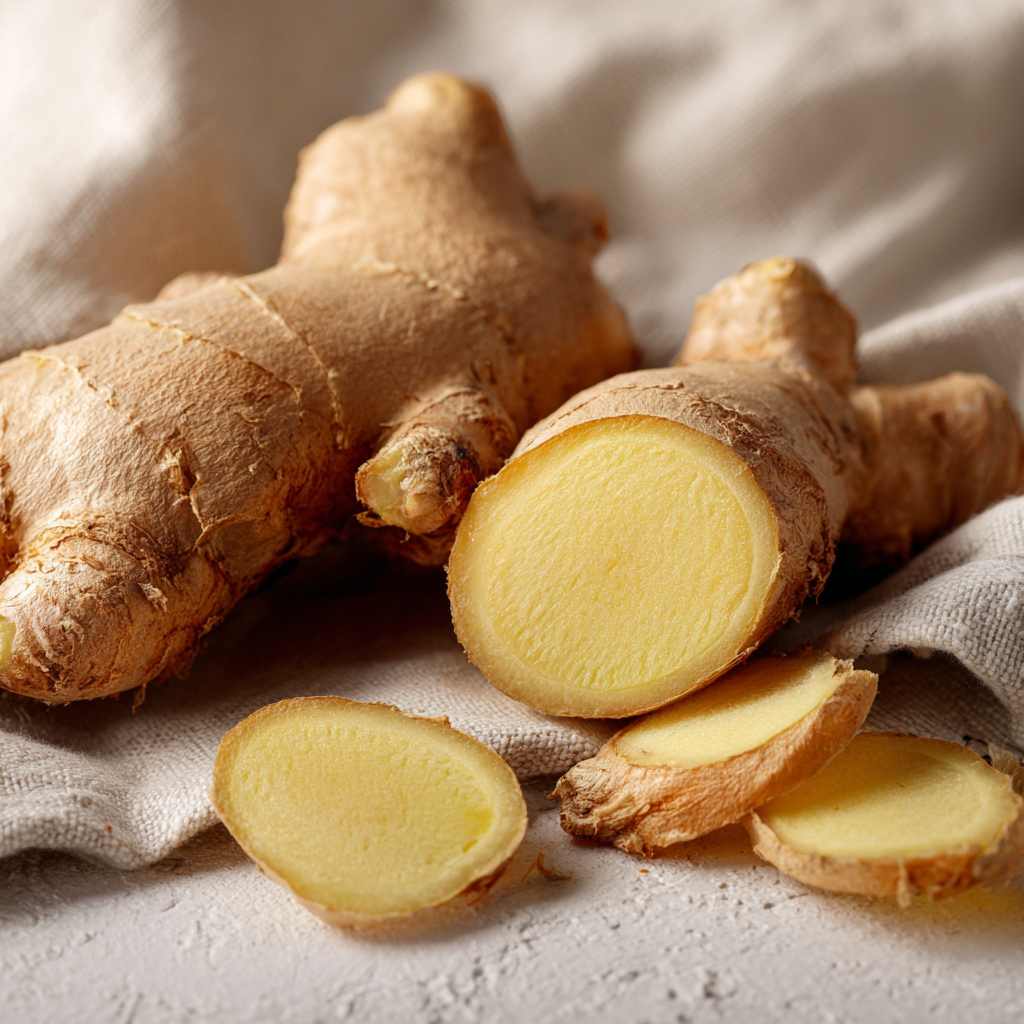
Ginger is the herb that always shows up at the right moment. Nauseous while traveling — ginger. Sick and chilled — ginger. Muscles sore after exercise — ginger. It is one of the most versatile medicinal plants on Earth, and it has been at the top of the list of trusted herbal remedies for at least five thousand years.
Confucius ate ginger at every meal. Arab traders introduced it to Europe in the Middle Ages, where it was so valuable that a pound of ginger was worth as much as a sheep. Traditional Chinese medicine, Ayurveda, and Greek medicine all used it — for a variety of complaints, but with the same conviction: ginger works. Today, science confirms what herbalists have always known.
What exactly is ginger?
Ginger (Zingiber officinale) is a tropical plant whose underground rhizome — the ginger root — is the part used. The plant is native to Southeast Asia and is now grown worldwide in tropical regions.
Fresh ginger is pale yellow inside with a thin, papery skin. Dried and ground ginger has a more concentrated and slightly different flavor profile — both are useful, but for different applications.

The main active compounds are gingerols (dominant in fresh ginger) and shogaols (dominant in dried ginger, formed when gingerols are heated or dried). Gingerols give fresh ginger its sharp, fresh heat. Shogaols are more potent anti-inflammatories and are considered the primary medicinal components.
If you want to know more check out this blog Ginger: properties, uses and flavor — complete guide
Why is ginger so good for you?
1. Ginger is proven effective against nausea
This is the most researched and most reliable benefit of ginger. A review of twelve randomized controlled trials concluded that ginger was significantly more effective than placebo at reducing nausea — in pregnancy-related nausea, motion sickness, chemotherapy, and postoperative nausea. One gram of ground ginger per day is the amount that has been consistently effective in studies. It is one of the few natural remedies that really works.
2. Ginger inhibits inflammation and relieves pain
Ginger inhibits the same inflammatory pathways as ibuprofen — notably the COX-1 and COX-2 enzymes — but without the stomach side effects. Studies show that it measurably reduces muscle soreness after exercise, joint pain in osteoarthritis, and menstrual pain. A clinical trial from 2015 showed that two grams of ginger powder per day reduced exercise-induced muscle pain by 25 percent over eleven days. The effect is gradual but real and cumulative.
3. Ginger supports the immune system
Fresh ginger has demonstrated antiviral activity against respiratory pathogens. A 2013 study showed that fresh ginger juice inhibited RSV — a common respiratory virus — more effectively than dried ginger. The warming effect also stimulates circulation and promotes sweating, the natural mechanisms by which the body fights infections. A ginger-lemon tea at the first signs of a cold is not only comforting — it has a demonstrable effect.
4. Ginger helps with blood sugar regulation
Like cinnamon, ginger has consistent evidence for improving insulin sensitivity and lowering fasting blood glucose. A randomized controlled trial from 2015 showed that three grams of ginger powder per day significantly lowered fasting blood sugar and HbA1c in people with type 2 diabetes. It also stimulates digestion and fat metabolism.
How do you use ginger?
In tea: Peel a thumb-sized piece of fresh ginger and slice it. Steep it in two cups of water and simmer on low for ten minutes. Add fresh lemon juice and honey. The longer you let it steep, the stronger and more medicinal the tea becomes.
In the kitchen: Fresh ginger works excellently in stir-fries, curries, soups, and marinades. Ground ginger is ideal in baked goods, cookies, and hot drinks. Both forms are effective, but fresh has the strongest antiviral action.
As a tonic: Combine fresh ginger with turmeric, black pepper, and lemon for a powerful daily tonic. Black pepper increases the absorption of curcumin in turmeric by up to 2000 percent — a recommendation worth combining with ginger as well.
More ideas can be found here 7 healthy morning shots with herbs
Fresh vs. dried ginger: when do you use which?
Fresh ginger is strongest for antiviral activity and has the freshest, sharpest flavor. Use it in teas, tonics, and dishes where ginger plays a prominent role.
Dried ground ginger contains more shogaols — more potent anti-inflammatory compounds. Use it in baked goods, curries, and as a supplement. It is also more shelf-stable and easier to dose.
Store fresh ginger root for two to three weeks in the refrigerator, or freeze it whole — you can then grate it directly without peeling.
Frequently asked questions about ginger
1. Is ginger good for your health?
Yes, ginger is one of the most well-researched medicinal plants in the world. The main benefits are relieving nausea, inhibiting inflammation and pain, supporting the immune system, and regulating blood sugar. It is safe for daily use in culinary amounts and is globally recognized as an effective herbal remedy.
2. How much ginger per day is healthy?
Up to four grams per day is considered safe for most adults. One gram of ground ginger per day is the amount shown to be effective against nausea in studies. During pregnancy, it is advised not to use more than one gram per day. If you are using blood thinners, always consult a doctor first, as ginger has a mild blood-thinning effect at high doses.
3. Does ginger really help with nausea?
Yes, this is ginger's most consistently proven benefit. Multiple clinical studies and a review of twelve trials confirm its effectiveness for various forms of nausea, including pregnancy-related nausea, motion sickness, and nausea from chemotherapy. The active compounds gingerols and shogaols act both on the gastrointestinal tract and on the vomiting center in the brain.
4. What is the difference between fresh and ground ginger?
Fresh ginger contains mostly gingerols — responsible for the fresh, sharp heat and the antiviral activity. Ground ginger contains more shogaols — more potent anti-inflammatory and analgesic. For nausea and viral infections, fresh ginger works best. For inflammation and pain complaints, ground ginger is at least equally effective. In the kitchen both are interchangeable, although fresh ginger gives a fresher and sharper result.
5. Can I combine ginger with other herbs?
Yes, and this works very well. Ginger pairs excellently with cinnamon, turmeric, star anise, and lemon. The combination of ginger and turmeric with black pepper is particularly powerful: the piperine in black pepper drastically increases the absorption of curcumin in turmeric, while ginger enhances the anti-inflammatory effect. No known negative interactions exist between these herbs.