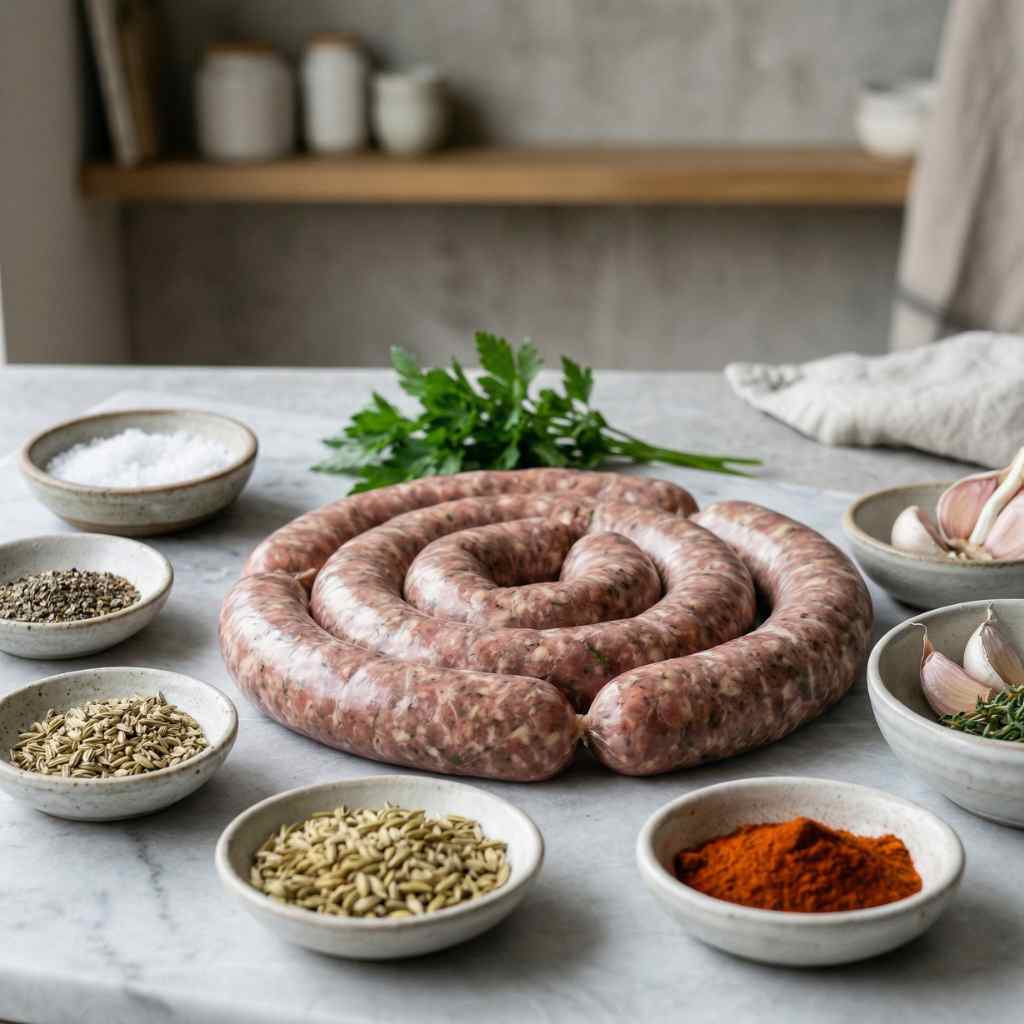
What could be more beautiful than making your own sausages? It is a craft passed down through generations and today being rediscovered by home cooks and chefs looking for real flavour. Whether you choose a juicy bratwurst, a firmly aged dry sausage or an authentic smoked sausage: making your own sausage not only gives satisfaction, but also full control over quality, fat percentage and seasoning.
In this blog we take you step by step. From the right tools to choosing meat and spice mixes – so you can confidently make your first artisanal sausage.
Preparations: what do you need?
Good news: you need less than you might think.
1. Meat grinder
A meat grinder is used to grind meat into mince. Don’t have one? You can ask the butcher to grind the meat for you, or buy freshly pre-ground mince. Pay close attention to the ratio of lean meat to fat.
Tip: always work with well-chilled meat. It grinds more easily and results in a better texture.
2. Sausage stuffer
With a sausage stuffer you fill the casings with the seasoned mince mixture. Traditionally pork or sheep casings are used, but collagen and cellulose casings are also fine alternatives nowadays. With these two tools you can get surprisingly far.
Three types of sausage: where do you start?
Each type of sausage has its own character. Below we explain how to make three classics: bratwurst, dry sausage and smoked sausage.
1. The basics: bratwurst
Bratwurst is the perfect entry-level sausage. You stuff it, cook it right away and you don't need to dry or smoke it.
Which meat do you choose?
-
Pork: 75% lean meat and 25% fat
-
Beef: 80% lean meat and 20% fat
Game can also be used if you want something different.
Seasoning
After grinding, add a good bratwurst mix. This forms the solid base of flavour. Want to vary? Add, for example, fennel, parsley or clove for extra depth. Then fill the casings using the sausage stuffer. Make the nozzle slightly moist, slide the casing on and fill slowly and evenly. For the exact procedure we gladly refer you to the bratwurst recipe on our website, where step by step is explained how to twist the perfect bratwurst.
Making currywurst?
Want to make a currywurst? Grill your bratwurst and serve it with curry sauce and curry powder. Simple, but irresistible.
2. Making dry sausage yourself
Have a bit more patience? Then dry sausage is a beautiful next step. Allow for about four weeks of drying time.
Basics
Dry sausage usually uses pork. Work with well-chilled meat and ensure accurate ratios.
Spices and fermentation
Use a good dry sausage mix. This contains acid and dextrose to start the fermentation process. That gives the sausage its characteristic complex flavour. You can add extra spices such as clove or garlic for your own twist.
Colorozo (prague powder)
Colorozo – also known as curing salt – is added to inhibit bacterial growth, extend shelf life and retain the nice deep red colour. After filling, let the sausages dry at a temperature between 12 and 15 degrees and a humidity of about 70%. After roughly four weeks check whether the sausage is sufficiently dried. Then it is ready to slice and serve.
3. Smoked sausage: a Dutch classic
A blog about making sausage is not complete without smoked sausage. The base is similar to bratwurst or dry sausage, but with one important difference: after filling the sausage is smoked.
What do you add?
-
A smoked sausage mix, such as the Gelderland smoked sausage mix
-
Curing salt
-
Flavoring paste
After filling, let the sausages dry for about 12 hours.
Smoking
Traditionally you smoke in a smokehouse. Pay close attention to the temperature: smoking too hot can cause spoilage. Don’t have a smokehouse? You can use liquid smoke flavor. Mix one part liquid smoke with three parts water and dip the sausage for about four minutes. Then hang the sausage up again to dry further. For exact proportions we gladly refer you to the smoked sausage recipe on our website.
Why make sausage yourself?
Making sausage yourself requires attention and precision, but yields a lot. You decide the ingredients, choose your own fat percentage and create a unique flavour. You also help preserve a beautiful craft. For all three types of sausages we have carefully composed spice mixes in our range to help you get started. That gives you a solid base, after which you can experiment with your own signature blend. It takes some time, but the satisfaction when you slice into your own sausage? That is priceless.
Serve your homemade sausage with a smart sauce choice
A good sausage doesn’t only stand or fall with the spices and meat, but also with what you serve with it. Want to enjoy without adding unnecessary calories? Combine your homemade bratwurst or smoked sausage with one of our low calorie sauces from the Natural Zero range. These sauces contain less sugar and fat, but retain that full flavour that pairs perfectly with artisanal meat.
Whether you choose a fresh mustard-like variant for smoked sausage or a creamy sauce for a grilled bratwurst: with the right sauce you lift your homemade creation to the next level. View the full range here:
https://www.naturalspices.nl/marinades-en-sauzen/natural-zero-sauzen
Making sausage yourself: frequently asked questions (FAQ)
1. What is the ideal fat ratio for homemade sausage?
For pork sausage 75% lean meat and 25% fat is ideal. For beef 80% lean and 20% fat. Fat provides juiciness and flavour.
2. Can I make sausage without a sausage stuffer?
In theory it can be done with a piping bag or funnel, but a real sausage stuffer gives a much better and more even result.
3. Is curing salt mandatory?
Not for fresh bratwurst. For dry sausage and smoked sausage it is strongly recommended due to shelf life, colour retention and food safety.
4. How do I know if dry sausage has succeeded?
The sausage should feel firm, have clearly lost weight and have no unpleasant odor. When in doubt: do not consume.
5. Can I experiment with other spices?
Absolutely. Think of fennel, chili, garlic, nutmeg or smoked paprika powder. Start with small amounts and note your ratios.