If you've ever made a dish from Arab cuisine, you've undoubtedly come across this spice mix: ras el hanout. “The best of the shop” is what ras el hanout means in Arabic. Traditionally it is a blend of the best herbs and spices a spice merchant has to offer, and that's why this spice mix should not be missing from Natural Spices' assortment!
Because “the best the spice merchant has to offer” can vary from day to day, there is no single definitive list of spices that make up ras el hanout. Each spice merchant or family has their own “secret” mix, but there are certainly a few basic spices that you see in almost every ras el hanout. In this blog we go into those basic spices, why ras el hanout can contribute to good health, how you can make this Arab spice mix yourself, and how to use it! Care to read along?
What is ras el hanout?
Ras el hanout is a spice mix that is mainly used in Arab cuisine. You often see it listed in dishes from Turkey, Algeria and Morocco. It is a versatile spice mix that adds a warm and complex flavor. Especially in stews such as tajine and rice and couscous dishes, ras el hanout gives that characteristic warm North African aroma.
Besides adding a warm, complex flavor to your dishes, we can also attribute various health benefits to ras el hanout. Ras el hanout is a mix of many different spices, each of which can contribute to health in its own way.
For example, in an earlier blog we talked about the health benefits of cayenne pepper. By adding cayenne pepper to ras el hanout you can make a spice mix that helps with colds. Or consider the anti-inflammatory properties of turmeric, a spice you also often see in ras al hanout. And what about cinnamon, which boosts metabolism and helps regulate blood sugar levels—also a welcome guest in this spice mix. Of course it depends on the composition of the ras el hanout, but by adding specific spices, using ras el hanout can help you lead a healthy life.
How can you make ras el hanout yourself?
But where do you start if you want to make this spice mix yourself? In practically every ras el hanout we see the following aromatic herbs and spices recurring, which you can use as a base for your own ras el hanout: cinnamon, coriander, cumin, ginger, turmeric, nutmeg, cardamom, allspice, clove and black pepper. To this you can add, to taste, a whole range of other spices, such as cayenne pepper, galangal, paprika powder, celery seed, and the list goes on. By mixing these spices together you create your homemade ras el hanout! And because the possibilities are endless it's good to experiment with different compositions, so you can make a ras el hanout that for you is “the best of the shop”!
If you find the endless possibilities overwhelming and prefer to start your ras el hanout adventure in a “safe” way, you can also go for a ready-made ras el hanout. For example, in our assortment we have the Yalla Yalla spice mix, which is a ras el hanout with no fewer than 18 different herbs and spices. In this spice mix we have blended all our favorite herbs and spices, which does justice to the name. That way you don't have to experiment yourself and buy all the spices separately, while you can still enjoy the delicious warm and complex flavor of ras el hanout.
If you prefer an organic ras el hanout that is also salt-free, you can indulge yourself. We have recently added the Hanout Harmony, as part of a set of four Bio Specials, to our assortment! Composed with only organic herbs and spices, free of salt and no E-numbers, so you can responsibly enjoy an authentic ras el hanout.
How can you use ras el hanout?
Now that you know what ras el hanout is and how you can make it yourself, we'd like to take you through two Arab dishes in which ras el hanout is the star of the show. We hope to inspire you to dive into the kitchen yourself and taste what ras el hanout has to offer.
Recipe 1: An Arab classic: ras el hanout chicken with couscous
First, a true Arab classic. Chicken, couscous and ras el hanout is a combination you often see in Arab cuisine. That's why this is a dish we definitely don't want to withhold from you when we talk about ras el hanout. With this dish you can dive straight into Arab cuisine and taste what ras el hanout has to offer.
To begin, take two chicken breasts, sprinkle each with one tablespoon of ras el hanout and salt and pepper to taste. Make sure both sides of the chicken breasts are evenly coated with the spices. Then heat two tablespoons of olive oil in a large frying pan, in which you fry the chicken breasts until golden brown. When the chicken is cooked, remove it from the pan. Keep them warm, for example in a closed container or wrapped in aluminum foil.
Because we will fry the vegetables and couscous in the same pan, they will also pick up the delicious flavor of ras el hanout. For vegetables in this dish we use two finely chopped cloves of garlic, a chopped onion and a red and yellow bell pepper cut into cubes. Fry these in the same frying pan in which the chicken was cooked, until the vegetables are soft.
Then add 150 grams of uncooked couscous and stir everything well. Then pour in 350 ml of chicken broth, cover the pan and let it simmer for about 5 minutes. In the meantime you can cut the chicken breast into strips, which can be placed on the couscous after 5 minutes. To finish the dish you can garnish it with chopped cilantro, or if you don't like that, parsley for some extra color and freshness. That way you can put a warm and spicy couscous on the table within 20 minutes — enjoy in an Arab way!
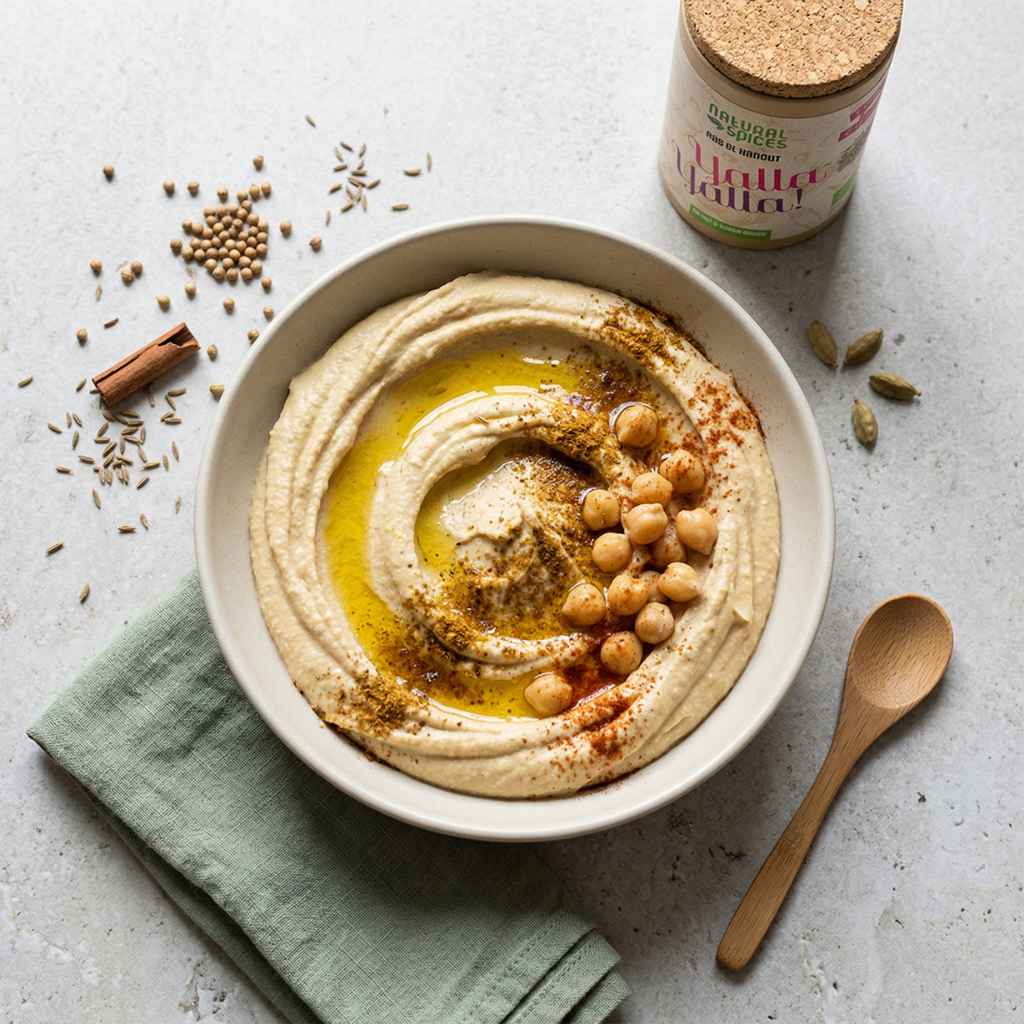
Recipe 2: Ras el hanout hummus
Although we gave you a recipe above that is typically Arab, hummus is perhaps the most well-known dish from Arab cuisine. And especially with ras el hanout you can give hummus a spicy and aromatic kick, taking it to the next level.
To start you need a can of chickpeas, the base of hummus. Drain the chickpeas (tip: save the liquid — the aquafaba — so you can use it to adjust the consistency of the final result) and rinse them well. Then put the chickpeas in a food processor or blender. To this add 3 tablespoons of tahini, 2 cloves of garlic, a generous splash of lemon juice and one tablespoon of ras el hanout. Then mix or blend the ingredients until smooth. If you find the hummus still a bit coarse you can add aquafaba, the liquid in the can of chickpeas (which hopefully you saved!), as desired. Add this until the hummus reaches the desired consistency.
Then season the hummus further with salt and pepper. You can also add a splash of lemon juice after blending if you want it fresher, or another pinch of ras el hanout if you don't find it spicy enough. Then scoop the hummus out of the food processor or blender into a serving bowl, after which you can garnish it with fresh cilantro or parsley. And for a real finishing touch you can add a pinch of paprika powder to give a red color (we eat with our eyes too) and add a bit of warmth to the hummus.
This hummus can then be served with Lebanese flatbread, pita bread or sliced carrot and cucumber. Delicious for dipping as a starter or during a gathering!
Time to experiment!
Above we have taken you into the world of ras el hanout, the spicy and warm flavoring from Arab cuisine. As we mentioned above there is no real recipe for ras el hanout and every spice merchant or family has its own “secret” recipe. That's why ras el hanout is the perfect spice mix to experiment with — make a ras el hanout that for you is “the best of the shop”!
If you don't feel like or don't have time to experiment, we are happy to help with the Yalla Yalla spice mix or the organic Hanout Harmony. Both spice mixes are interpretations of ras el hanout, in which we have combined our favorite spices that fit well with Arab cuisine to create a delicious flavoring. We have taken plenty of time to experiment to create the best balance of flavors, so we are sure these spice mixes will also appeal to you.
Which spices will go into your unique ras el hanout? And which dishes will you make with it? We are very curious! To start, you can get inspiration from the two dishes we mentioned above. And as a bonus we have another recipe fully written out on our website: the Yalla Yalla pumpkin soup. The possibilities with this versatile flavoring are endless. Enjoy and bon appétit!
Frequently asked questions about ras-el-hanout
1. What does ras-el-hanout literally mean?
Ras-el-hanout literally means ‘the head of the shop’ in Arabic. It refers to: the best that the spice merchant has to offer. It is traditionally a carefully composed blend of the finest spices from his assortment.
2. Which spices are in ras-el-hanout?
That varies by region and by maker. A classic ras-el-hanout often contains spices such as cumin, coriander seed, cinnamon, ginger, turmeric, cardamom, nutmeg and clove. Some variants also contain rose petals or even lavender. So there is no fixed composition — that is precisely what makes the blend so special.
3. Is ras-el-hanout spicy?
Ras-el-hanout is usually warm and aromatic, but not extremely hot. The blend is more about depth and complexity than about heat. Some variants contain some pepper or chili, but in general it is a mild to medium-spiced mix.
4. What do you use ras-el-hanout for?
Ras-el-hanout is widely used in North African cuisine, for example in tajines, couscous dishes, stews and roasted vegetables. It is also delicious in soups, with lamb, chicken or even stirred into hummus or yogurt for extra depth.
5. Is ras-el-hanout healthy?
Yes, ras-el-hanout consists of pure spices without additives (depending on the quality). Many of the used spices, such as turmeric, ginger and cinnamon, are known for their antioxidant and anti-inflammatory properties. It is also a natural way to give dishes more flavor without adding extra salt.