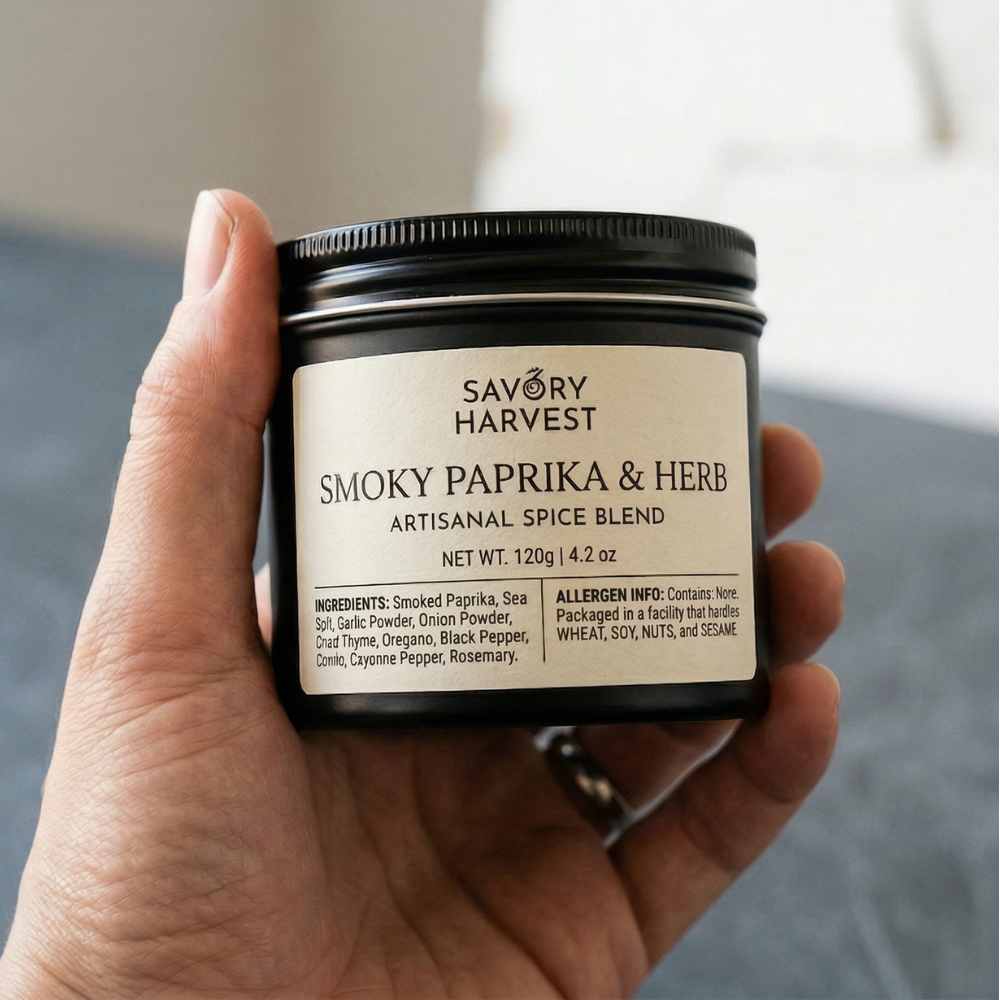
If you develop a private label food product — whether that is an herb mix, a sauce, a seasoning or a condiment — correct labelling is not optional. It is one of the most common areas where first-time private label customers experience delays, rejections by retailers or costly reprints of packaging. Done correctly, however, your label is also one of your most powerful tools: it builds trust, communicates quality and can actively support your premium positioning.
This guide covers the core requirements for both the EU and the UK markets, the main differences between the two, and what private label buyers should keep in mind when briefing their manufacturing partner.
-
- Introduction
- Why labelling for private label is more important than ever
- The EU framework: Regulation 1169/2011
- The UK framework: Divergence after Brexit
- The 'Not for EU' label: What private label brands selling in the UK need to know
- Allergen labelling: No room for mistakes
- Clean label and health claims: Opportunities and obligations
- Packaging and sustainability compliance: The emerging layer
- A practical checklist for private label customers
- Working with the right manufacturing partner
- Sources
Why labelling for private label is more important than ever
For private label products the labelling responsibility rests entirely with you as the brand owner. Unlike purchasing from a national brand where the manufacturer carries that burden, you as the client of a private label product are the responsible food business. That means you are legally liable for the accuracy and compliance of everything on the packaging.
Under EU law, the labelling, advertising and presentation of food must not mislead the consumer about the characteristics or effects of the product. The same principle is embedded in UK law. Making mistakes is not only a legal risk — it damages the consumer trust you are trying to build through your own brand.
The EU framework: Regulation 1169/2011
The foundation of EU food labelling law is Regulation (EU) No 1169/2011, which sets out the general principles, requirements and responsibilities for food information to consumers, and in particular for labelling. The regulation applies to food businesses at all stages of the food chain where their activities are related to providing food information to consumers, and covers all foods intended for the final consumer.
All prepacked foods sold in the EU must clearly state the following: the product name that clearly indicates the nature of the food; an ingredients list in descending order of weight including additives; allergen information where each of the 14 regulated allergens is emphasized using contrasting fonts, styles or backgrounds; the net quantity; and a date marking with 'Best before' or 'Use by'.
In addition to these basic requirements, a nutritional declaration per 100 g or 100 ml is mandatory for most prepacked products, and the name and address of the responsible food business must be shown on the label.
Language requirements are an important consideration for private label customers selling in multiple EU markets. Food labelling provided to the final consumer must be in a language easily understood by them, which is generally interpreted as the language of the country of sale. If you sell simultaneously in France, Germany and the Netherlands, you will typically need multilingual packaging or market-specific labels. This has direct implications for your packaging budget and lead times — account for this from the start.
Country of origin is a growing focus. For herbs and sauces in particular, origin claims are increasingly used as a quality signal — and if you make such a claim, you must be able to substantiate it with full traceability documentation. Additional information can give details about a specific aspect of the product such as origin or production method, and manufacturers should bear in mind that national voluntary and mandatory labelling schemes may also apply.
The UK framework: Divergence after Brexit
The United Kingdom has largely retained EU food labelling law after Brexit — the core requirements around ingredients, allergens, nutritional declarations and date marking have remained broadly the same. However, the two frameworks are increasingly diverging, and that divergence is accelerating.
Both the UK and the EU require clear, legible and accurate labels. Mandatory information includes the product name, ingredients, allergen information, net quantity, best-before/use-by date and nutritional declaration. The differences do matter, though.
The most significant practical difference for private label customers is the address requirement. In Great Britain a UK business address must appear on the label. In the EU any address in a member state is acceptable. Products sold in Northern Ireland must follow the EU labelling rules and display an EU or Northern Ireland address. If you sell on both markets, this means you cannot simply use a single label — you will need market-specific versions, or a carefully designed label that meets both requirements.
We should expect the differences between UK and EU food information rules to increase over time due to divergence, which will become a real challenge for companies active in both markets. Keeping up with this is not a one-off exercise — it requires ongoing monitoring.
The 'Not for EU' label: What private label brands selling in the UK need to know
One of the more complex post-Brexit developments is the 'Not for EU' labelling requirement, which stems from the Windsor framework that governs trade between Great Britain and Northern Ireland. As of 1 July 2025 the scope of products requiring the 'Not for EU' label was expanded under the Windsor framework, and it affects a wide range of goods including eggs, fish, fruit, vegetables and composite foods.
For composite food products such as ready meals and confectionery, companies had until October 2025 to comply, while the deadline for other categories was extended to July 2026. If you produce in Great Britain and distribute to Northern Ireland — or if your products may move via that supply chain — you must check whether your product category falls within the scope and ensure your packaging layout meets the requirement. Non-compliance can lead to products being refused entry into Northern Ireland under the Retail Movement Scheme.
This is an area where working with an experienced manufacturing partner who understands the regulatory landscape adds real value — the rules are still evolving and the consequences of non-compliance are both commercial and legal.
Allergen labelling: No room for mistakes
For herb mixes and sauces, allergen management is one of the high-risk areas of labelling regulation. Many herb mixes contain, or are processed in factories that handle, celery, mustard, sesame, gluten-containing cereals and tree nuts — all part of the 14 allergens regulated under both EU and UK law.
All 14 regulated allergens must be emphasized in the ingredients list using contrasting fonts, styles or backgrounds. This is not optional formatting — it is a legal requirement. 'May contain' statements for cross-contamination risks are not uniformly regulated worldwide; each country applies its own rules and guidance. In the Netherlands these statements fall under general food law and, while not explicitly legally mandatory, are considered indispensable in practice and increasingly demanded by retailers as part of their due diligence.
A nuance to bear in mind is that allergen labelling rules — including exemptions for highly refined ingredients — can differ between regions. While the EU provides specific exemptions for certain processed derivatives, these are not always mirrored in the UK. This creates real divergence and underscores the need to assess allergen decisions at the ingredient level market by market. Always request full allergen documentation from your manufacturing partner for each ingredient and each mix, including cross-contamination risk assessments. This documentation supports your label approval and protects you in a retailer audit or consumer complaint.
Clean label and health claims: Opportunities and obligations
Clean label is an important commercial driver in the private label market for herbs and sauces. Shorter ingredient lists, no artificial colours or preservatives, and recognisable ingredients all contribute to premium positioning. Clean label, however, is a marketing concept, not a legal term — and the claims you make on the packaging must be substantiated.
Health claims are tightly regulated. In the EU only claims that are permitted under the EU register of nutrition and health claims may be used. The retained version of that register applies in the UK. This means you cannot simply state that your turmeric mix 'supports immunity' or that your low-sodium herbs are 'good for the heart' without a specific permitted claim formulation. If you plan to use functional or health positioning as part of your private label strategy, confirm the permitted claim wording with your regulatory advisor before it even approaches your packaging design.
Organic and non-GMO claims bring their own certification requirements. Organic certification in the EU requires an external audit and approval by a certification body — it cannot simply be claimed on the label without that documentation. If you sell in the EU, the Packaging and Packaging Waste Regulation also mandates harmonised labelling with details on material type, sorting instructions and recyclability status, and possibly multiple official languages depending on the target countries.
Packaging and sustainability compliance: The emerging layer
A newer and increasingly important dimension of labelling regulation relates to the packaging itself. The upcoming EU packaging legislation — the Packaging and Packaging Waste Regulation (PPWR) — introduces binding requirements for recyclability, labelling and waste reduction across the EU, with 12 August 2026 as the general application date. For private label customers planning product launches in 2026 and beyond, packaging material choices made today will need to meet recyclability and labelling requirements that are about to come into force.
Recyclability claims, material composition documentation and labelling inputs must be traceable at SKU level — not reconstructed afterwards under audit pressure. For private label brands building a premium, sustainable positioning, this is actually an opportunity: having your sustainability documentation in order before the deadline signals professionalism to retail buyers and gives you an edge over competitors who are still struggling with compliance.
A practical checklist for private label customers
Before you approve a private label label design for EU or UK sale, run through the following:
- Confirm that all mandatory labelling elements are present: product name, full ingredients list in descending order of weight, allergen emphasis, net quantity, date marking, nutritional declaration and name and address of the responsible food business.
- Verify your address requirements: UK address for Great Britain, EU or Northern Ireland address for Northern Ireland, address in an EU member state for EU markets.
- Check allergen documentation for each ingredient, including cross-contamination risk at the production facility level.
- If you make origin claims, ensure full traceability documentation is available that will stand up to retailer or authority scrutiny.
- Assess health or nutrition claims against the permitted claims register for your target market before including them in your packaging design.
- If you sell in Northern Ireland, check whether your product category requires 'Not for EU' labelling under the Windsor framework.
- For EU launches from mid-2026, evaluate packaging material choices against the requirements of the Packaging and Packaging Waste Regulation (EU) 2025/40.
- Build a labelling review into your product development timeline — changes in the design stage are cheap; changes after a print run are not.
Working with the right manufacturing partner
Labelling regulation is not something to be solved at the end of a product development project. The most effective approach is to discuss this in the briefing stage, before the formulation is finalised. Ingredient choices, allergen control in the production facility, origin claims and packaging formats all have labelling implications — and the earlier these are understood, the smoother your route to market will be.
A good manufacturing partner will routinely provide you with full ingredient traceability documentation, allergen statements, technical data sheets and production facility certifications. They will also flag formulation changes — however small — that may require a label update, and they understand the difference between what you need for the German market versus what you need for the UK market.
Labelling regulation is not glamorous. But for private label brands building long-term relationships with retailers and consumers, it is the foundation upon which everything rests.
This article is intended as a general overview and does not constitute legal advice. Regulatory requirements change regularly — always verify current requirements with a qualified food law specialist before finalising label designs for a market.
FAQ: Labelling regulation for Private Label in the EU and the UK
1. Am I as a private label client responsible for the labelling, or is that the manufacturer?
As the private label client you are the responsible food business — not the manufacturer. This means your name and address appear on the packaging and you are legally liable for the accuracy of all information on the label. A good manufacturing partner will provide the necessary documentation and technical substantiation, but the ultimate responsibility for what is on the packaging lies with you. Make sure you build a label check into your process for every formulation change — however small.
2. Can I use one label for the Dutch, Belgian and UK markets?
That is difficult and in most cases not advisable. The Dutch and Belgian markets are subject to EU rules, meaning labelling must be in the language of the country of sale — Dutch for the Netherlands and Dutch or French for Belgium, depending on the region. The UK market is subject to post-Brexit rules, including the requirement to display a UK business address instead of an EU address. You can, however, work with cleverly designed multilingual labels that meet all requirements, but always have these checked by a regulatory specialist before approving a print run.
3. What should I do if my herb mix is produced in a factory that also processes nuts or gluten?
This is one of the most critical points for herb mixes and sauces. If your product is produced in a facility that also handles allergens, you must assess this risk and communicate it on the label. In practice this typically means a 'may contain' statement for the relevant allergens. Always request an up-to-date allergen matrix from your manufacturing partner for the entire production site, not just for your specific recipe. Retailers increasingly demand this documentation as part of their procurement process, and missing or incorrect allergen information is one of the most common reasons for product recalls.
4. May I claim on my private label product that it is 'organic' or 'clean label'?
For clean label, this is a marketing term without a legal definition — you may use it, but the contents of your product must support the claim. Avoid artificial additives, colourings and preservatives if you choose this positioning, and ensure your ingredient list reflects that promise. For organic it is different: in the EU 'organic' is a protected term that may only be used if the product is certified by a recognised certification body. Without that certification you may not use the word organic — or variants such as 'bio' — on your label or in your marketing communications. Ask your manufacturing partner which certified organic ingredients are available and what the certification documentation entails.
5. How often do labelling rules change and how do I keep up?
More often than most private label clients expect. Both the EU and the UK regularly update regulations — think of updates around allergen exemptions, new packaging legislation such as the PPWR coming into force in August 2026, or post-Brexit changes like the 'Not for EU' labelling. The EU and the UK are also evolving increasingly in different directions, which means a product that is compliant in both markets today may not be in two years' time. Practical advice: build an annual labelling review into your product calendar, subscribe to updates from the Food Standards Agency and the European Commission, and work with a manufacturing partner who proactively flags changes that affect your product line.
Sources
- Regulation (EU) No 1169/2011 of the European Parliament and of the Council on the provision of food information to consumers — EUR-Lex, European Union
- Regulation (EU) 2025/40 on packaging and packaging waste (PPWR) — EUR-Lex, European Union
- EU register of nutrition and health claims — European Commission
- UK food labelling requirements after Brexit — Food Standards Agency (FSA), gov.uk
- Windsor framework: 'Not for EU' labelling — UK government guidance, gov.uk
- Food labelling: the basics — Food Standards Agency, food.gov.uk
- Allergen labelling for food manufacturers — Food Standards Agency, food.gov.uk
- EU-UK regulatory divergence in food labelling — Food law analysis, various sources