

When you go barbecuing or cooking with herbs, you'll quickly encounter two techniques: a marinade and a dry rub. Both add flavor, but the effect on your dish is completely different. By understanding the difference well, you can more easily choose the right approach and get more out of your ingredients.
What is a marinade?
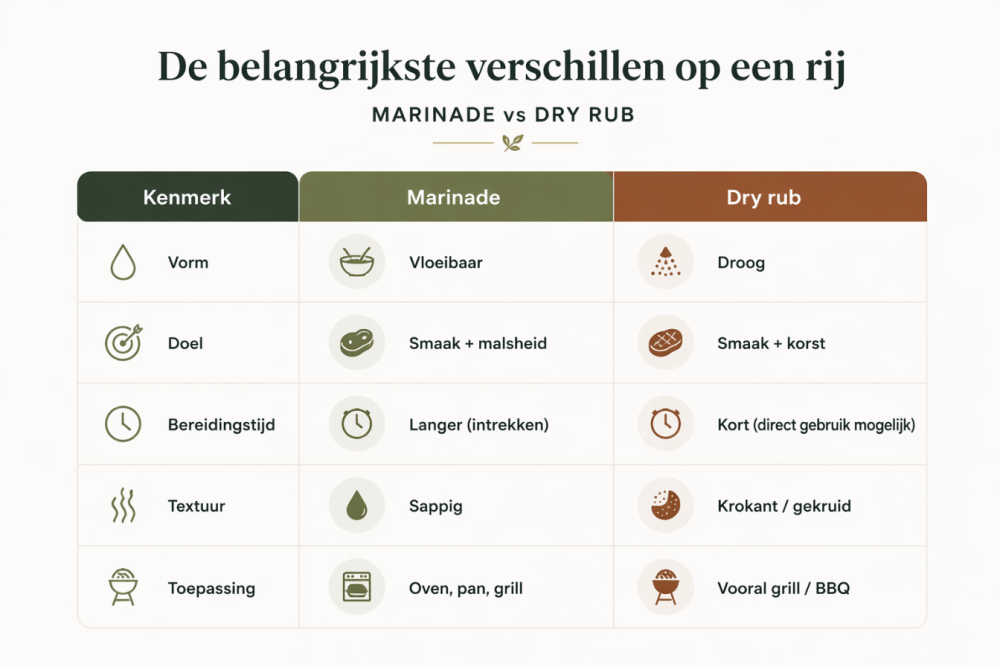
A marinade is a liquid mixture in which you let meat, fish or vegetables soak. Usually composed of:
- Acid (lemon, vinegar, yogurt)
- Fat (oil)
- Flavorings (herbs, spices, garlic)
A marinade not only adds flavor, but also helps make meat more tender and juicier. This makes it especially suitable for larger cuts of meat or longer cooking processes.
When do you use a marinade?
- For larger cuts of meat (chicken, beef, lamb)
- If you want to retain juiciness
- When you have time to let it soak in
What is a dry rub?
A dry rub is a dry spice mix that you rub directly onto your ingredients. During cooking or grilling a spiced crust (bark) forms that provides lots of flavor and texture.
When do you use a dry rub?
- For BBQ and grilling (ribs, pulled pork, chicken)
- If you want a crispy exterior
- When you want to work quickly
Examples: which rub do you use when?
Want to keep it simple with a consistent flavor? Then ready-made rubs are a good choice:
- For ribs, pulled pork or belly: Porky’s Rub
- For beef such as steak or brisket: Beef BBQ Chief
- For chicken (BBQ, oven or airfryer): Rosemary’s Chicken
These rubs are ready to use and tailored to the type of meat.

What if you mix a dry rub with oil?
If you mix a dry rub with oil, you create a "wet rub" — a practical middle ground between a marinade and a dry rub.
Advantages:
- Better adhesion of spices
- More even flavor distribution
- Less chance of burning (especially with sugar in rubs)
- Faster results than marinating
When to use?
- For chicken breast, vegetables or quick BBQ dishes
- If you have little time
- For extra juiciness without long marinating
When not to use?
- For low & slow BBQ (like pulled pork)
- If you want a truly crispy bark
Tip: use a thin layer of oil — not too much.
BBQ on a larger scale or professionally?
Do you work in hospitality, organize events or barbecue on a larger scale? Then professional marinades are often the better choice. They provide consistent flavor, efficiency and scalability.
Check out the range Marinades
In closing
There is no right or wrong — only what suits your dish.
- Choose a marinade for tenderness and juiciness
- Go for a dry rub for bold flavor and crust
- Or use a wet rub (rub + oil) as a quick, practical middle ground
With the right choice, you can make any dish stand out.
Frequently Asked Questions (FAQ)
1. Which is better: a marinade or a dry rub?
That depends on the result you're looking for. A marinade is ideal if you want to make meat more tender and juicier. A dry rub is better if you want to create an intense flavor and a crispy crust, for example on the BBQ.
2. How long should you marinate meat?
At least 30 minutes, but for best results often 2 to 12 hours. Larger cuts of meat (such as chicken thigh or beef) can even marinate overnight. Note: marinating too long can damage the texture of meat, especially with acidic marinades.
3. Can you combine a dry rub and a marinade?
Yes, you can. You can first marinate for tenderness and then add a dry rub for extra flavor and a crust. This works especially well with BBQ dishes like chicken or spare ribs.
4. Is a dry rub healthier than a marinade?
Not necessarily. The difference is mainly in composition. A dry rub usually contains no oil, while a marinade often does. On the other hand, some rubs may contain sugar or salt. So it depends on the ingredients you use.
5. What is the advantage of a dry rub with oil (wet rub)?
A wet rub ensures that spices stick better and burn less quickly. It is a quick solution if you have little time, and gives more juiciness than a dry rub, without having to marinate for a long time.


